Customised Dreams
May manufacturers advertise in our dreams?
Overview
Customised Dreams is a speculative service-design project that imagines a future in which brain–computer interfaces can help people choose, generate, and experience dreams. The service is accessed through a smart pillow that supports sleep, reads signals during the night, and connects the sleeper to a library of designed dream experiences.
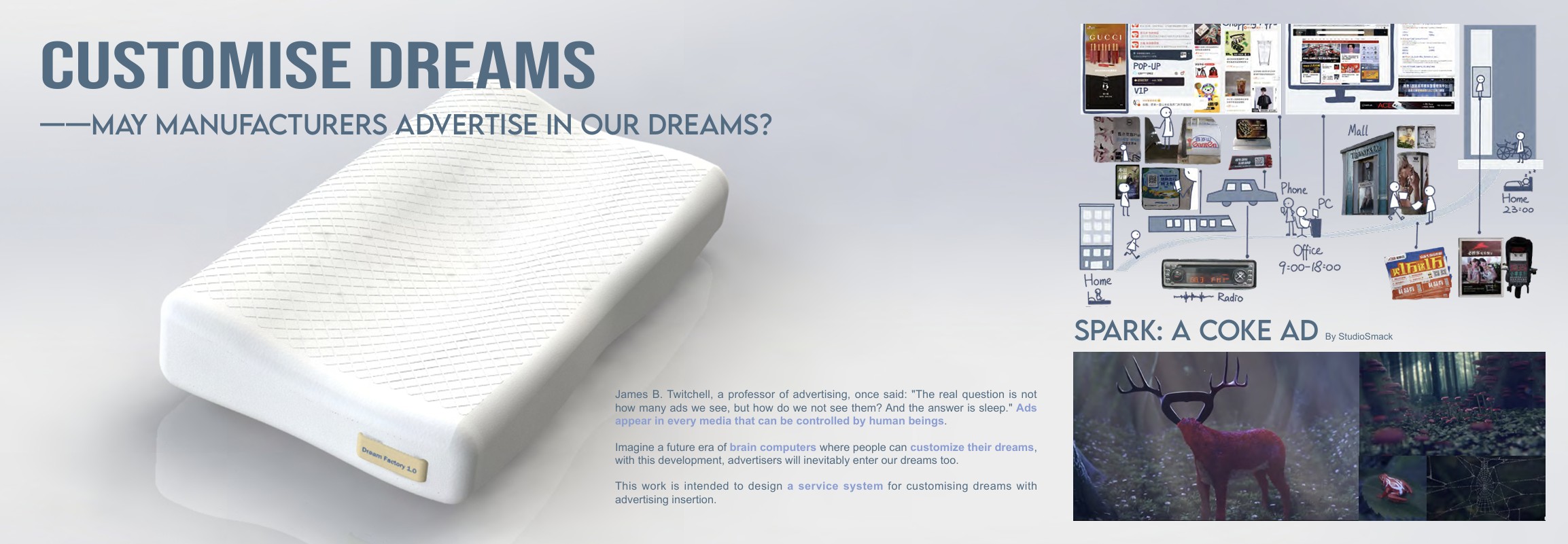
The proposal begins with an appealing promise: sleep could become more personal, useful, and meaningful. A user might travel somewhere impossible, rehearse an experience, revisit a memory, enter a fictional world, or simply choose a night without dreams. But if dreams become a controllable medium, they may also become commercial space. The service therefore includes targeted advertising as part of its business model and asks what happens when the final private hours of the day are opened to manufacturers.
The Question
If dreams can be designed and distributed, who gets to shape what we see while we sleep?
The project does not attempt to predict one inevitable future. Instead, it uses a plausible product and service to make an emerging tension tangible: the same technology that offers agency over our dreams could also make sleep measurable, purchasable, and open to persuasion.
Context: Advertising Enters Every Medium
Advertising tends to appear wherever human attention can be reached and measured. It follows us through streets, shops, radio, television, computers, and phones, filling the intervals between home, work, and leisure. Sleep appears to be an exception—not because it lacks value, but because it has not yet become an addressable medium.
Developments in brain–computer interfaces, sleep tracking, generative media, and dream research suggest a provocative future condition. If technology allows people to influence the content of their dreams, advertisers may eventually seek access as well. Customised Dreams turns that possibility into a service system so that its benefits and consequences can be examined together.
Reconstructing Dreams with AI
Dreams often combine familiar people, places, and anxieties in ways that are vivid but logically unstable. Early generative images share something of this quality: they are recognisable at first glance, yet full of improbable transitions and uncertain details.
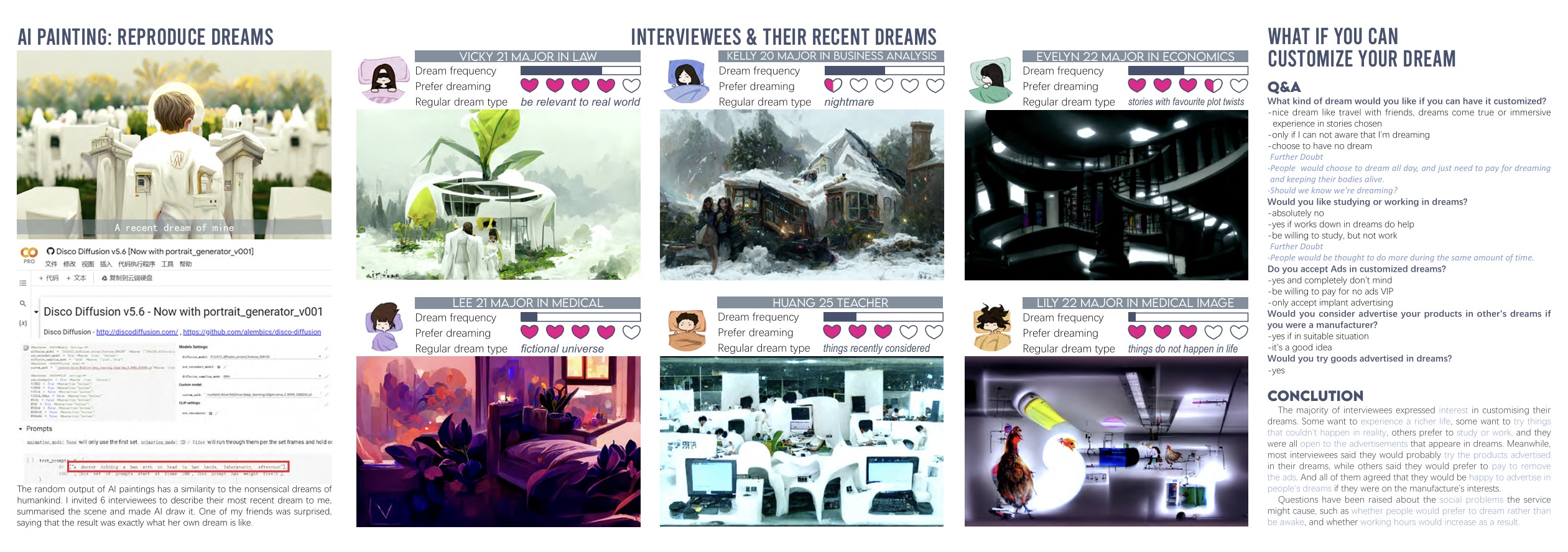
As an exploratory exercise, I invited six participants to describe a recent dream. I summarised each account as a prompt and used an AI image generator to reconstruct the scene. The images were not intended as accurate recordings. They became conversation objects—imperfect visual translations that helped participants discuss how a dream felt, what they remembered, and what a future dream-customisation service might need to preserve.
Interviews and Findings
The interviews explored dream frequency, preferred dream types, attitudes toward customised dreams, and the acceptability of commercial content during sleep. Participants imagined travelling with friends, entering favourite stories, experiencing things impossible in real life, studying, working, or choosing not to dream at all.
Most participants were interested in some form of dream customisation. Their motivations differed: some wanted a richer emotional life, some wanted access to impossible experiences, and others saw dreams as additional time for learning or self-development. Reactions to advertising were more complicated. Several participants would accept advertising in exchange for access, while others preferred to pay for an ad-free experience. Some said they might try products encountered in dreams, especially if those products felt relevant to the dream rather than interrupting it.
The conversations also exposed risks that a simple desirability survey could miss. Would people choose to dream all day? Would productivity expectations extend into sleep? Should a person know they are dreaming? And could a company design an advertisement so seamlessly that the sleeper experiences it as their own desire?
Research: Dreams and Brain–Computer Interfaces
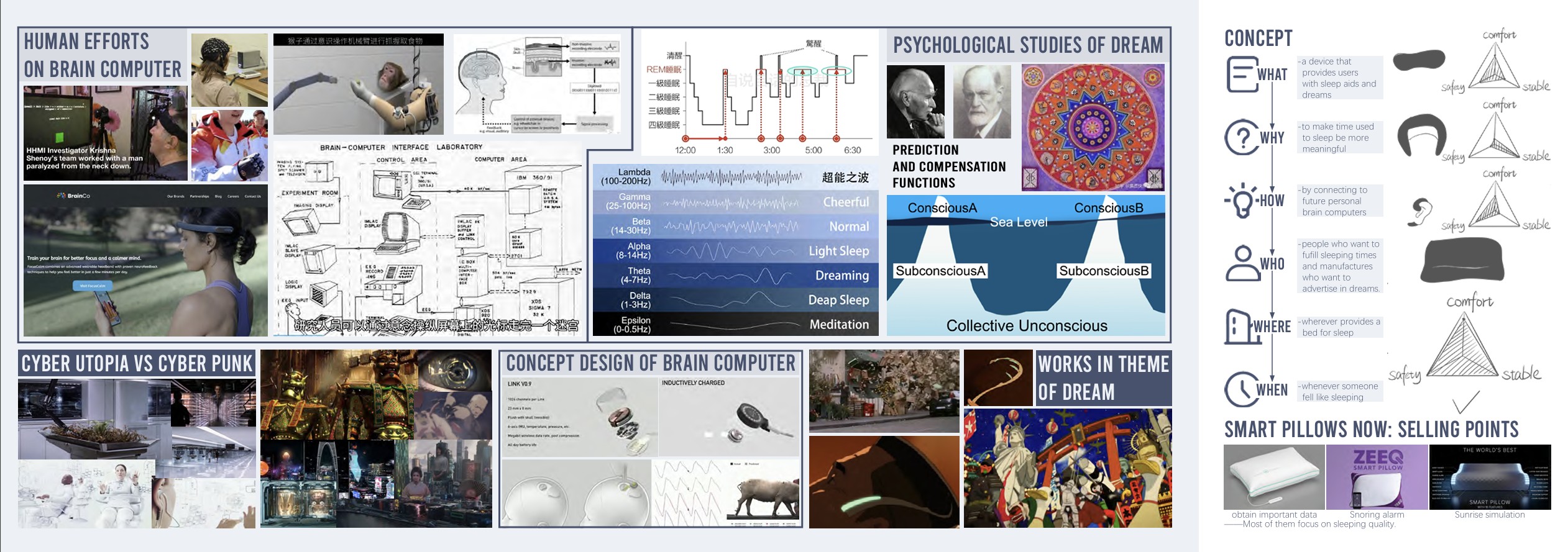
The concept was informed by research into sleep cycles, REM sleep, brainwave patterns, dream psychology, and the history of brain–computer interfaces. Psychological theories—from individual wish fulfilment to the collective unconscious—also offered different ways to consider whose material a designed dream might draw upon.
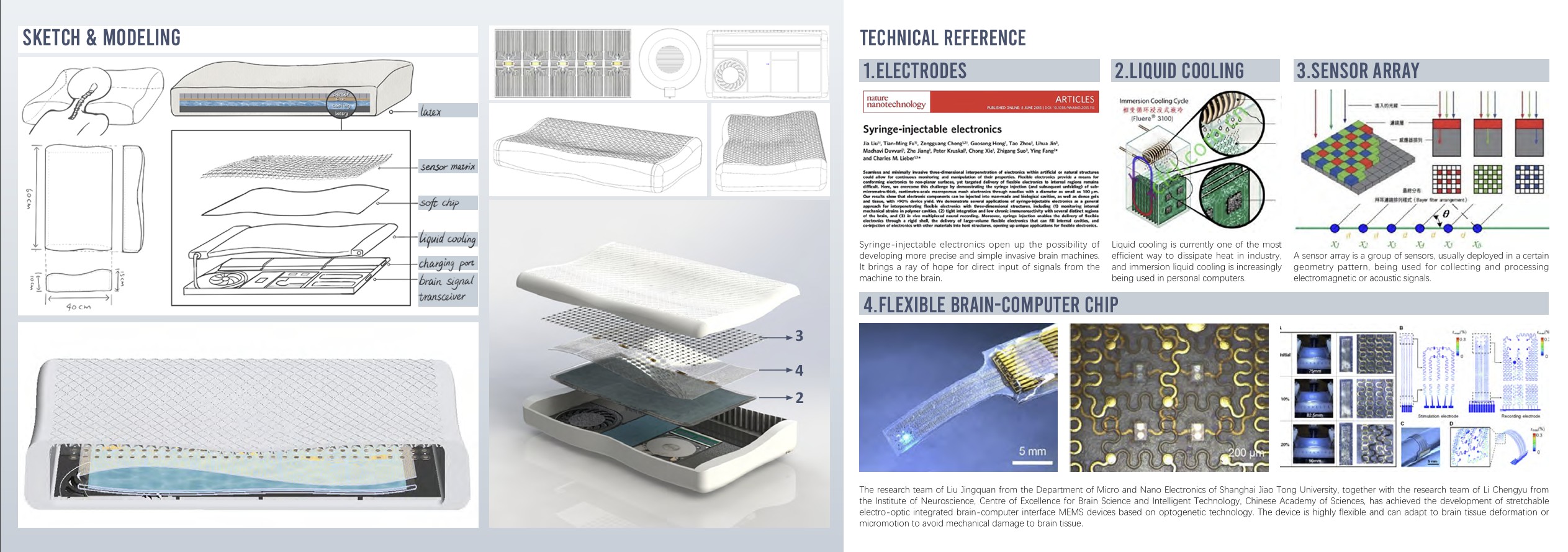
The technical research focused on signals that make the proposal legible rather than claiming that complete dream control is currently possible. Flexible electrodes, sensor arrays, compact cooling systems, and soft brain–computer interfaces suggest how future sleep hardware might become less clinical and more domestic. They provide a plausible technical vocabulary for the concept while leaving its speculative status visible.
Concept: The Smart Pillow
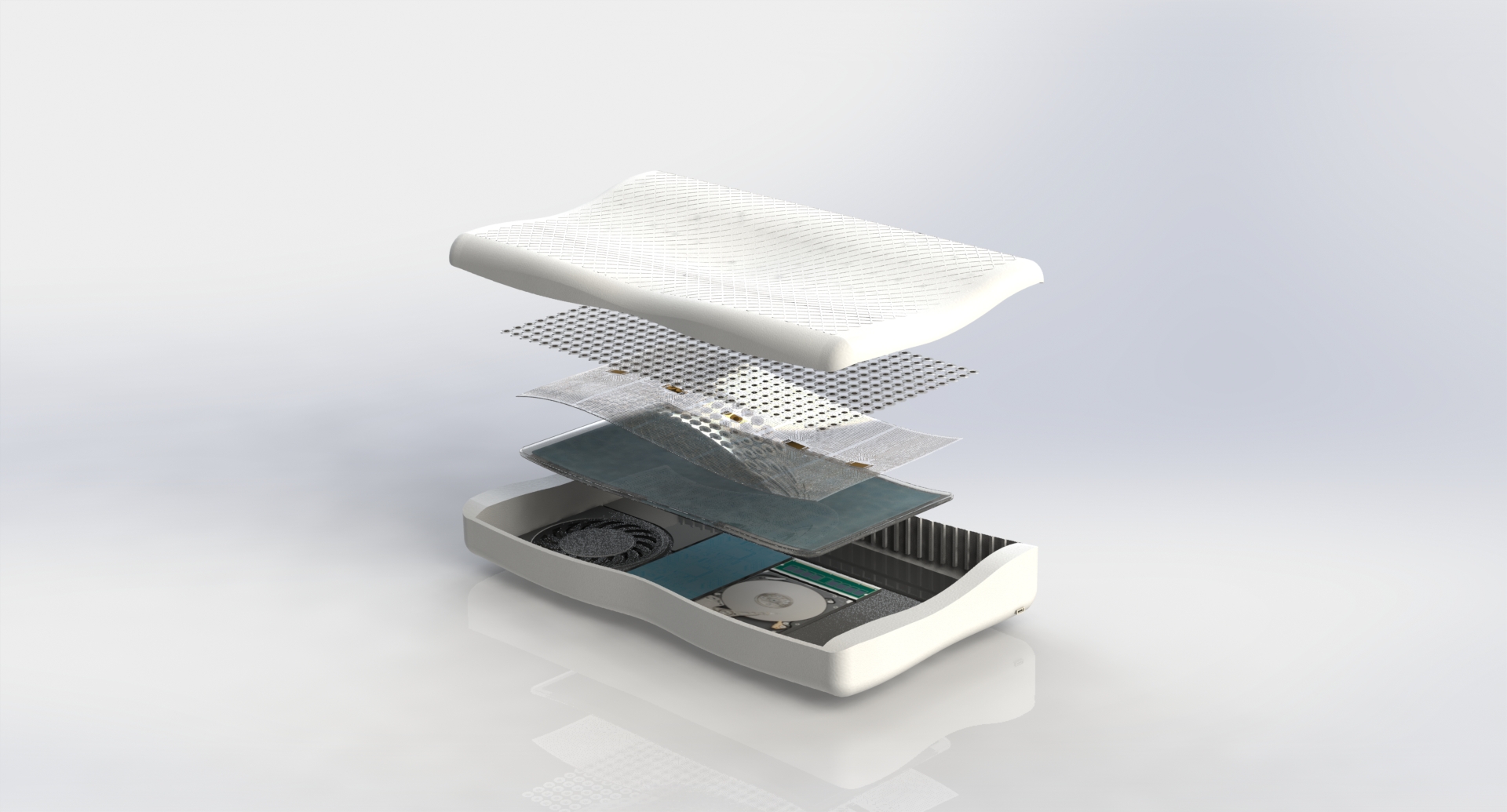
The service is embodied in a smart pillow: an ordinary, comforting object that conceals an extraordinary infrastructure. It acts as a sleep aid, a brain-signal interface, and a portal to a catalogue of dream experiences. Its familiar form makes the service feel domestic and desirable, while its hidden computational layers hint at the amount of technology and data required to deliver that comfort.
The pillow is intended for people who want to shape the time they spend asleep, as well as for manufacturers that want to distribute commercial messages through dreams. This deliberate conflict between user benefit and platform incentive is central to the proposal.
Anatomy and Technical Speculation
The imagined pillow combines a soft upper surface with a sensor matrix, flexible brain–computer layer, liquid-cooling structure, charging system, signal transceiver, and compact processing hardware. An array of contact points follows the contour of the sleeper’s head, while internal cooling and flexible components allow the device to remain soft enough for nightly use.
These components are presented as design speculation, not as a claim that contemporary hardware can reliably record or write complete dreams. Their role is to bridge current research and the proposed future service, making the experience concrete enough to question.
User Scenario
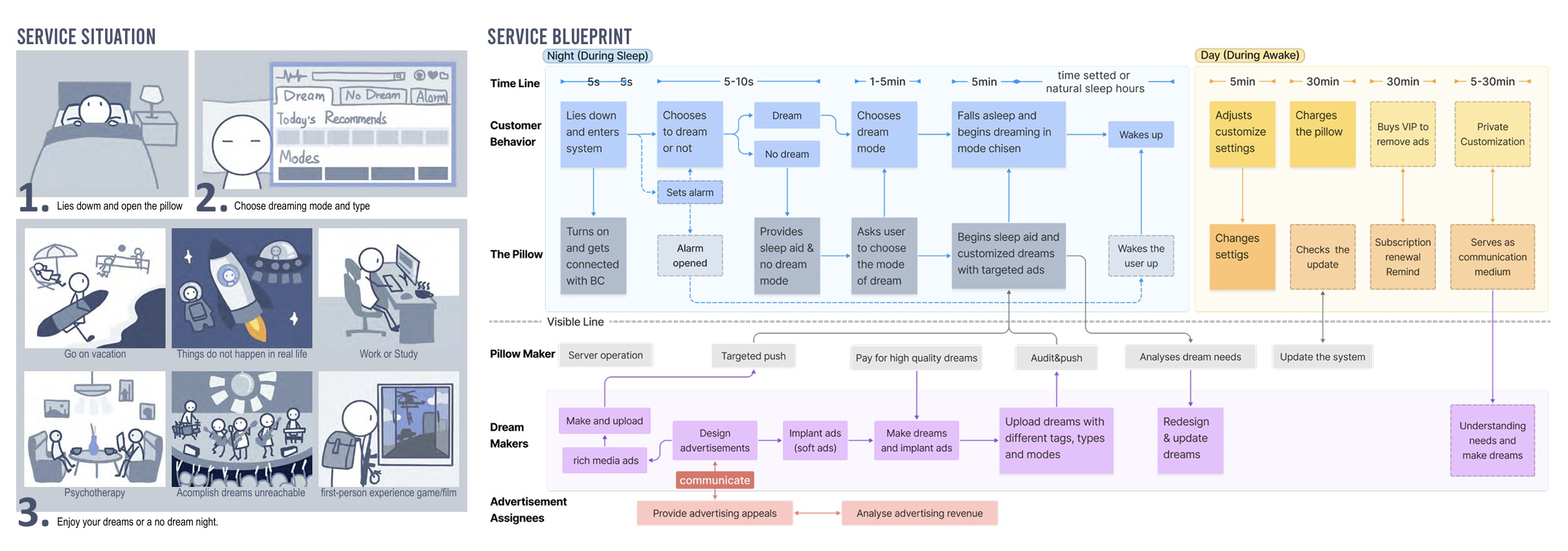
At night, the user lies down and connects to the pillow. They can choose Dream, No Dream, or Alarm, then select a dream mode and set a wake-up time. Dream modes might include travel, impossible experiences, work or study, psychotherapy, wish fulfilment, or a first-person film or game.
The pillow supports the user as they fall asleep and begins the selected experience during an appropriate sleep stage. Advertising may be woven into the dream as branded objects, places, characters, or events. In the morning, the user can adjust future settings, manage a subscription, or pay for an ad-free version of the service.
Service Blueprint
Behind the quiet bedtime interaction is a network of actors. The user chooses and experiences a dream. The pillow monitors sleep and provides the interface. The platform operates the service, analyses preferences, updates the system, and manages subscriptions. Dream Makers design, tag, upload, and revise dream experiences. Advertisers define campaign objectives and pay to place branded material inside them.
The system offers several possible exchanges: free or subsidised dreams supported by advertising, premium dream experiences, private customisation, and a VIP subscription that removes advertisements. As the platform learns what a person wants to dream about, it can improve recommendations—but the same knowledge makes increasingly intimate targeting possible.
Ethical Tensions
The proposal places convenience and intrusion in the same object. A pillow normally represents rest, safety, and withdrawal from public life. Here, it also becomes a sensing device, a media player, and a commercial channel.
Several questions remain deliberately unresolved:
- Who owns the signals, preferences, memories, and emotional responses collected during sleep?
- Can consent be meaningful when an advertisement is experienced inside a dream?
- How could a sleeper distinguish an implanted desire from one that feels like their own?
- Would premium, ad-free sleep become a privilege rather than a basic condition?
- Could employers and schools expect people to use dreams for additional work or training?
- What happens if designed dreams become more attractive than waking life?
Reflection
Customised Dreams began as a question about a new advertising medium, but developed into a wider investigation of ownership over mental space. The most important part of the project is not whether every technical component can be built today. It is the service logic that becomes imaginable once sleep can be measured and influenced.
The project also revealed a productive contradiction. Participants were curious about richer, more controllable dreams, even when they recognised the risks of advertising and behavioural influence. That tension makes the proposal plausible: systems of extraction rarely arrive only as threats; they arrive wrapped in convenience, pleasure, and personalisation.
Future development could examine consent mechanisms, dream-data governance, regulation, and ways of making commercial intervention perceptible within the dream itself. It could also explore an alternative model in which dream technology is treated as a private or public good rather than an advertising platform.