Euthanasia Helper
Life-Control Assistant is a speculative design project about autonomy, care, and the consequences of turning an irreversible personal decision into a technological service.
Overview
Euthanasia is debated across medicine, law, philosophy, economics, sociology, and anthropology, yet no single discipline can resolve when—if ever—a person should have the right to end their own life. The debate becomes even more complicated when technology is introduced as an intermediary.
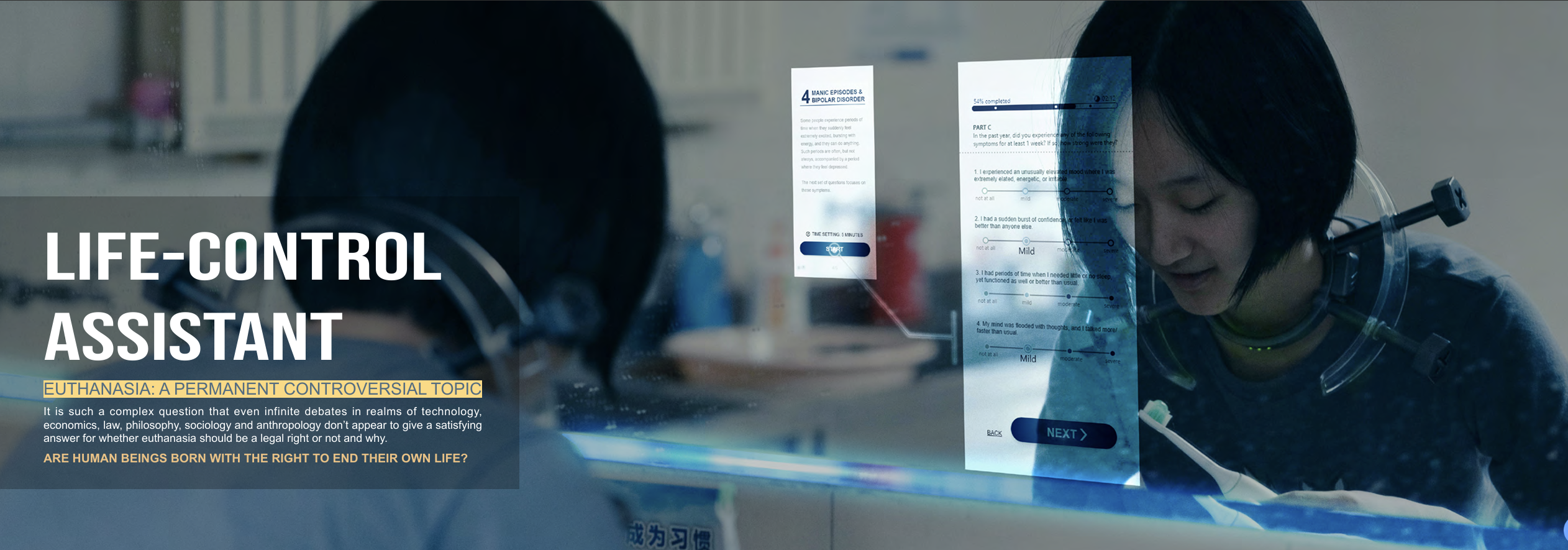
This project imagines a future system called Life-Control Assistant. It combines a neck-worn device, continuous physical-health monitoring, periodic mental-health assessment, and access to medical consultation. Rather than presenting the system as a solution, the project uses it to expose a conflict: can technology support personal autonomy without reducing an ethically complex decision to data, eligibility, and interface flow?
The Question
If a person is considered to have autonomy over their life, who—or what—should be allowed to determine whether that autonomy includes the right to end it?
The proposal asks how consent might be defined, verified, delayed, or challenged when a decision is influenced by illness, pain, mental health, family, law, and social inequality. It also asks whether a system designed to protect users could quietly become a system that categorises whose life is considered bearable, treatable, or economically valuable.
Definitions and Context
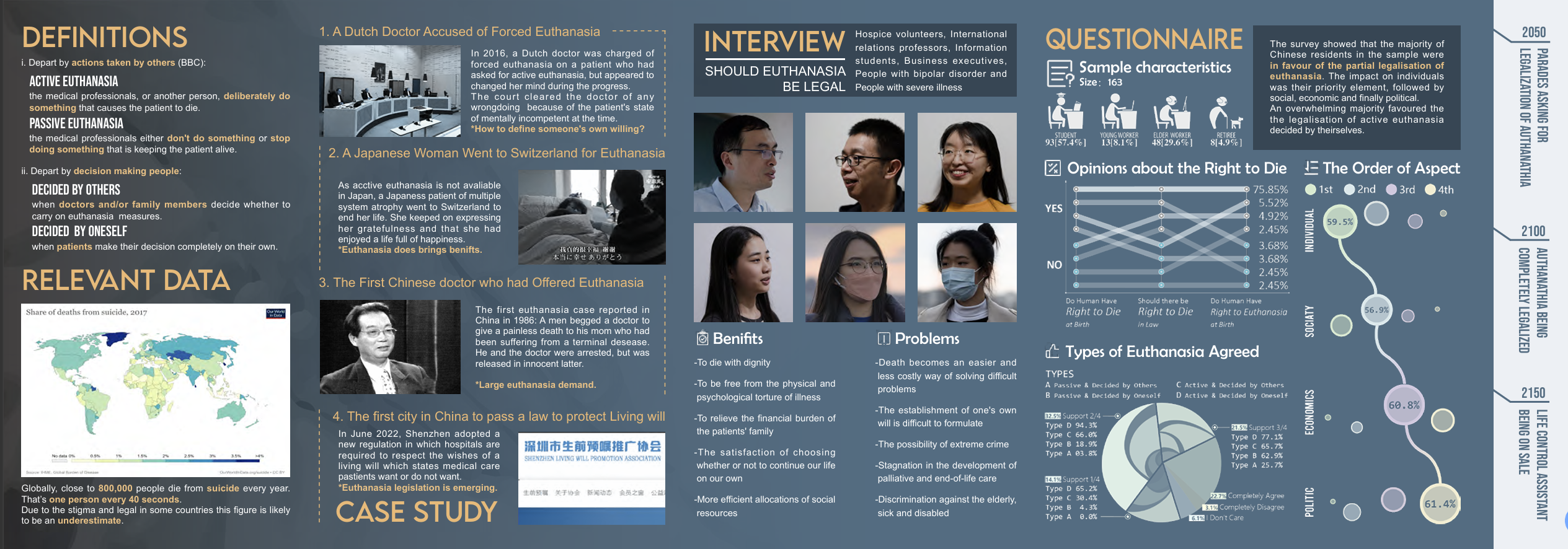
The early research separated euthanasia according to two distinctions. The first concerned how death occurs: active euthanasia, in which an action causes death, and passive euthanasia, in which treatment is withheld or withdrawn. The second concerned who makes the decision: the individual, or other actors such as doctors and family members.
These categories revealed that the issue is not only about death. It is also about agency, responsibility, medical authority, and the conditions under which a decision can be recognised as informed and voluntary.
Case Studies
Several cases were reviewed to understand how intention, capacity, medical responsibility, and legislation can conflict. They included a doctor accused of proceeding after a patient’s wishes became uncertain, a patient travelling abroad because assisted dying was unavailable at home, an early reported euthanasia case in China, and the emergence of living-will advocacy.
Together, the cases raised a recurring difficulty: a system may require a clear and stable expression of intent, while real decisions are often shaped by changing pain, fear, family relationships, mental state, and access to care. A declaration that appears unambiguous in an interface may be much less certain in lived experience.
Interviews and Questionnaire
The research combined interviews with a questionnaire of 163 respondents. Participants included students, professionals, older workers, retirees, people with bipolar disorder, and people living with severe illness. The conversations explored whether euthanasia should be legal, perceived benefits and risks, preferred forms of decision-making, and the relative importance of medical, social, economic, and political factors.
Many respondents supported some degree of legalisation, but their reasoning varied. Some prioritised dignity and relief from suffering; others focused on personal freedom, the burden placed on families, or the allocation of care resources. Concerns included coercion, discrimination, crime, the difficulty of establishing a stable will, and the possibility that easier access to death might weaken investment in palliative and mental-health care.
The research did not produce a simple mandate. Instead, it showed that support for a right to die can coexist with deep uncertainty about how that right should be administered.
Speculative System
Life-Control Assistant imagines a staged system rather than an immediate action. A wearable device records basic physical indicators, while a linked application periodically assesses mental health and connects the user with medical consultation. The service introduces time, repeated assessment, and professional contact between an initial intention and any irreversible outcome.
This structure is intentionally uncomfortable. Monitoring may appear to provide safety and evidence, but it also creates a record of intimate physical and psychological states. An eligibility system may reduce impulsive decisions, yet it also gives institutions and algorithms the power to judge whether a person’s wishes are legitimate.
Physical Health Monitoring
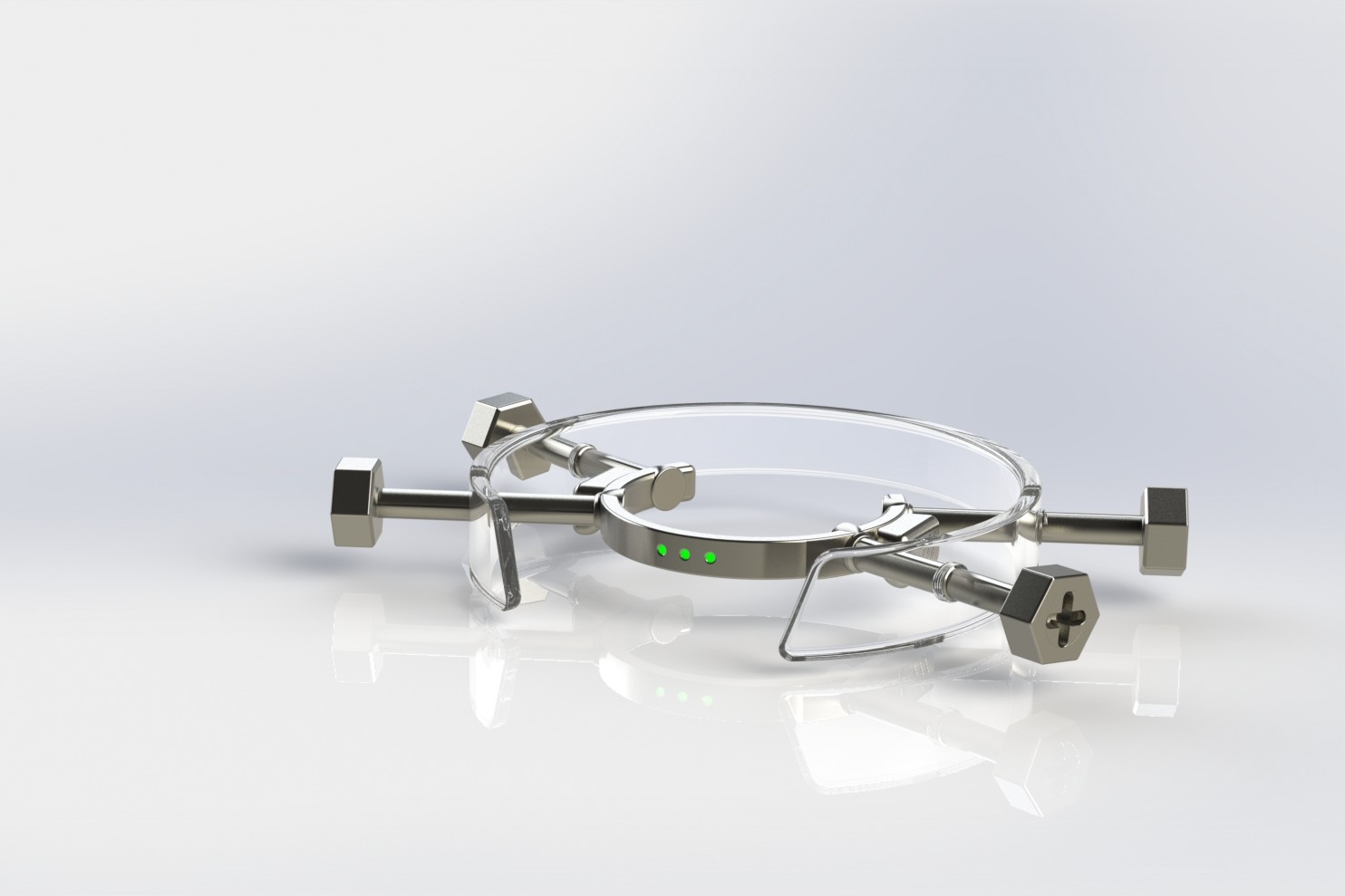
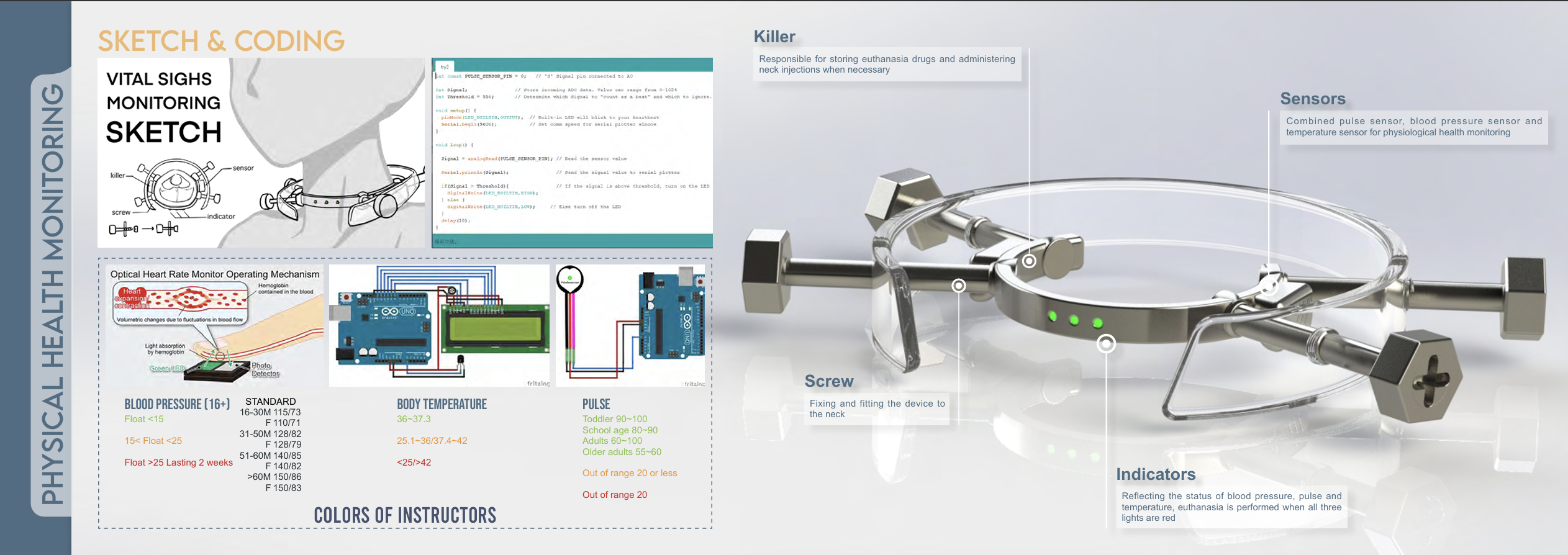
The neck-worn prototype combines pulse, blood-pressure, and temperature sensing within a rigid transparent collar. Indicator lights communicate the status of the monitored signals, while the visible mechanical form makes the system’s authority physically present on the body.
The prototype was developed through sketching, 3D modelling, basic electronic testing, and a wearable mock-up. Its speculative function is more important than its technical feasibility: it turns an abstract debate into an object that can be worn, observed, and questioned.
Mental Health Monitoring and Appointments
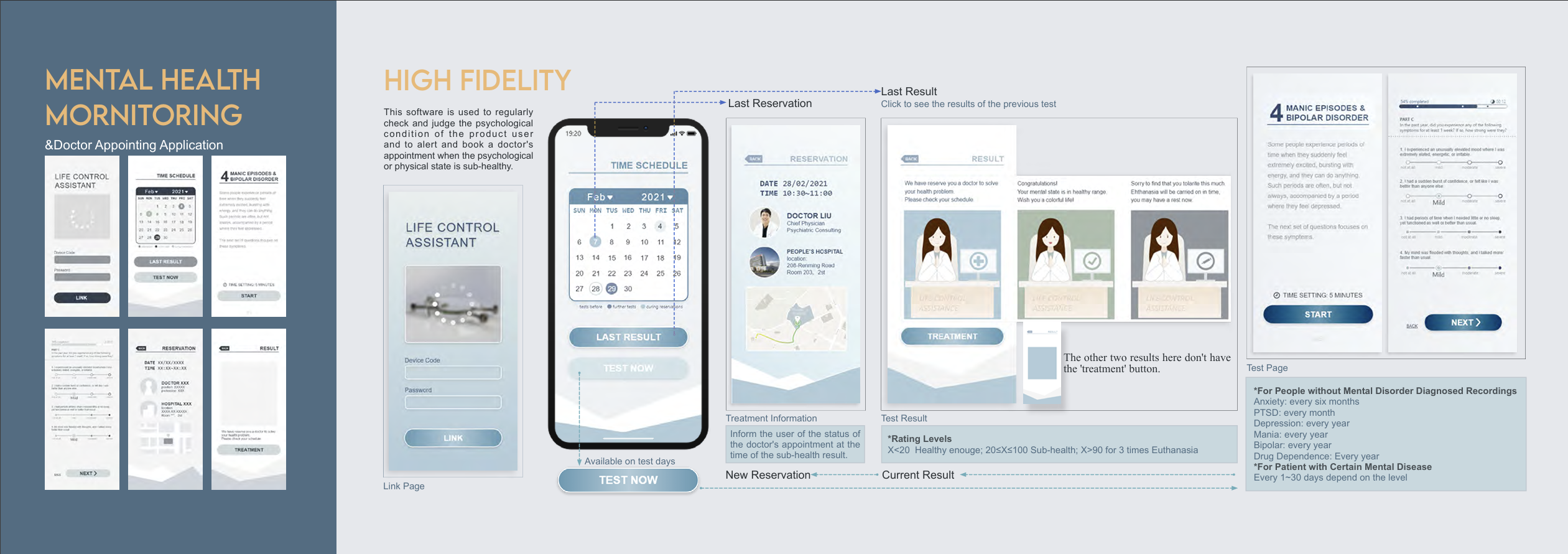
The companion application asks users to complete recurring mental-health assessments. The proposed frequency changes according to previous diagnoses and results. The interface also stores past results, schedules tests, and connects users with doctors for further assessment or treatment.
The application was designed as a high-fidelity mobile flow containing device connection, a calendar, questionnaires, results, treatment information, and appointment booking. Its calm visual language deliberately contrasts with the severity of the decision it mediates.
Scenario
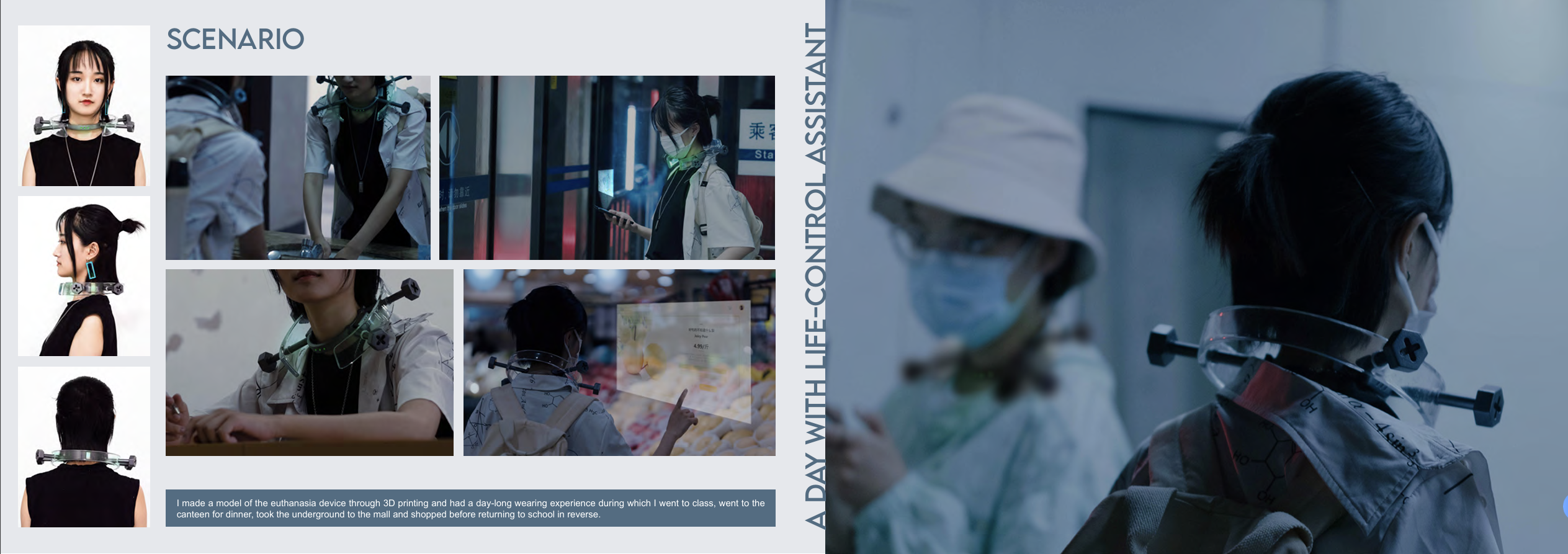
To examine how the object might feel in everyday life, I produced a wearable model and used it across an ordinary day—moving through classrooms, public transport, shops, and other shared environments. The scenario places a private and irreversible intention inside highly visible social situations.
The experience highlighted the contradiction between autonomy and exposure. A device intended to support personal choice also makes that choice legible to strangers, institutions, and systems. It could offer reassurance, but it could equally produce stigma, surveillance, pressure, or intervention.
Ethical Tensions
The project does not advocate euthanasia or propose a deployable medical device. It is a critical design probe intended to make several unresolved tensions visible:
- Can consent remain meaningful when pain, mental health, financial pressure, or family expectations change over time?
- Who owns and interprets the physical and psychological data collected by the system?
- Could monitoring protect a person from an impulsive decision, or become a mechanism for denying their stated autonomy?
- Would access be equal, or would economic and social inequality determine who receives care and who is offered an exit?
- Could a service built around the right to die unintentionally normalise death as an efficient response to problems that society has failed to address?
Reflection
Euthanasia Helper began with a question about the right to end one’s own life, but the design process shifted the focus toward the institutions that define, measure, and authorise that right. Once an intimate decision becomes a service, it requires thresholds, records, actors, timelines, and accountability. Every attempt to make the process safer also introduces another layer of control.
The most important outcome is therefore not the collar or the application. It is the tension embodied by the system: technology can make autonomy appear measurable while concealing the social conditions behind a decision. Future development could examine living wills, palliative care, data governance, consent over time, and alternative systems that prioritise sustained care without turning a speculative object into a medical prescription.